Chapter 14: Long-Term Vision & AI-Native Operations
“The goal of AI transformation is not to add AI to your company. It is to build a company that could not exist without it.”
Beyond the First Year
The work of Parts II through IV has been organized around a specific temporal horizon: the first year of AI transformation, from strategic planning through the mid-term operating phase. That horizon was deliberate. The first year is where most AI transformation programs succeed or fail, and the decisions made in that period determine whether the organization is building toward something durable or executing a one-time initiative that will stall when the initial momentum runs out.
This chapter looks past that horizon. It is concerned with what the organization becomes over the second, third, and fourth years of AI transformation, and with the strategic and organizational choices that determine whether the program produces compound advantage or diminishing returns. The distinction matters more than most technology leaders appreciate when they are still in the first year, because the decisions that produce compound advantage look different from the decisions that merely sustain the current level of AI capability, and those two paths diverge gradually and then suddenly.
The term that best captures the goal of the long-term horizon is one that has been used loosely and therefore somewhat emptied of meaning: AI-native. It is worth recovering the precision of the term, because it describes something meaningfully different from what most B2B SaaS companies have after the first year of AI transformation. AI-augmented means the organization has added AI capabilities to existing processes, roles, and workflows. AI-native means the organization has redesigned processes, roles, and workflows around what AI makes possible, in ways that would not be possible or practical without AI. The distance between those two states is substantial, and crossing it requires a different set of strategic investments than the first year demanded.
What AI-Native Actually Means
The distinction between AI-augmented and AI-native is not primarily a technical distinction. An AI-augmented company and an AI-native company can be running the same models, using the same infrastructure, and producing similar quality outputs. The difference is organizational and strategic: in the nature of the work the humans do, in how the product is designed and improved, in what the data infrastructure is built to support, and in the competitive advantages the organization is actually accumulating.
In an AI-augmented organization, AI assists humans with tasks they were already doing. The CS rep drafts responses faster. The dispatcher makes better routing decisions with AI suggestions. The product team ships features with AI-assisted development. The work is faster and better, but the fundamental shape of the work is unchanged. The organization’s operating model could be understood and described without reference to AI; AI is a capability that accelerates it.
In an AI-native organization, the AI systems are not accelerating existing workflows, they are constituting new ones. Customer onboarding does not look like the old process done faster; it looks like a fundamentally different process that the AI makes possible at all. The product improvement cycle does not look like engineers iterating more efficiently; it looks like a continuous improvement system that operates at a cadence and granularity that human-only review could not sustain. The competitive advantage is not that AI helps the organization do what competitors do, faster and cheaper. It is that the organization is doing things competitors cannot yet do because they have not built the infrastructure, the data assets, and the organizational capability that AI-native operation requires.
The long-term vision for B2B SaaS AI transformation, properly stated, is not “add AI to our product and operations.” It is “build the infrastructure, data assets, and organizational capability that allow AI to constitute our core competitive advantage, and that compound in value as the program matures.”
The Data Flywheel
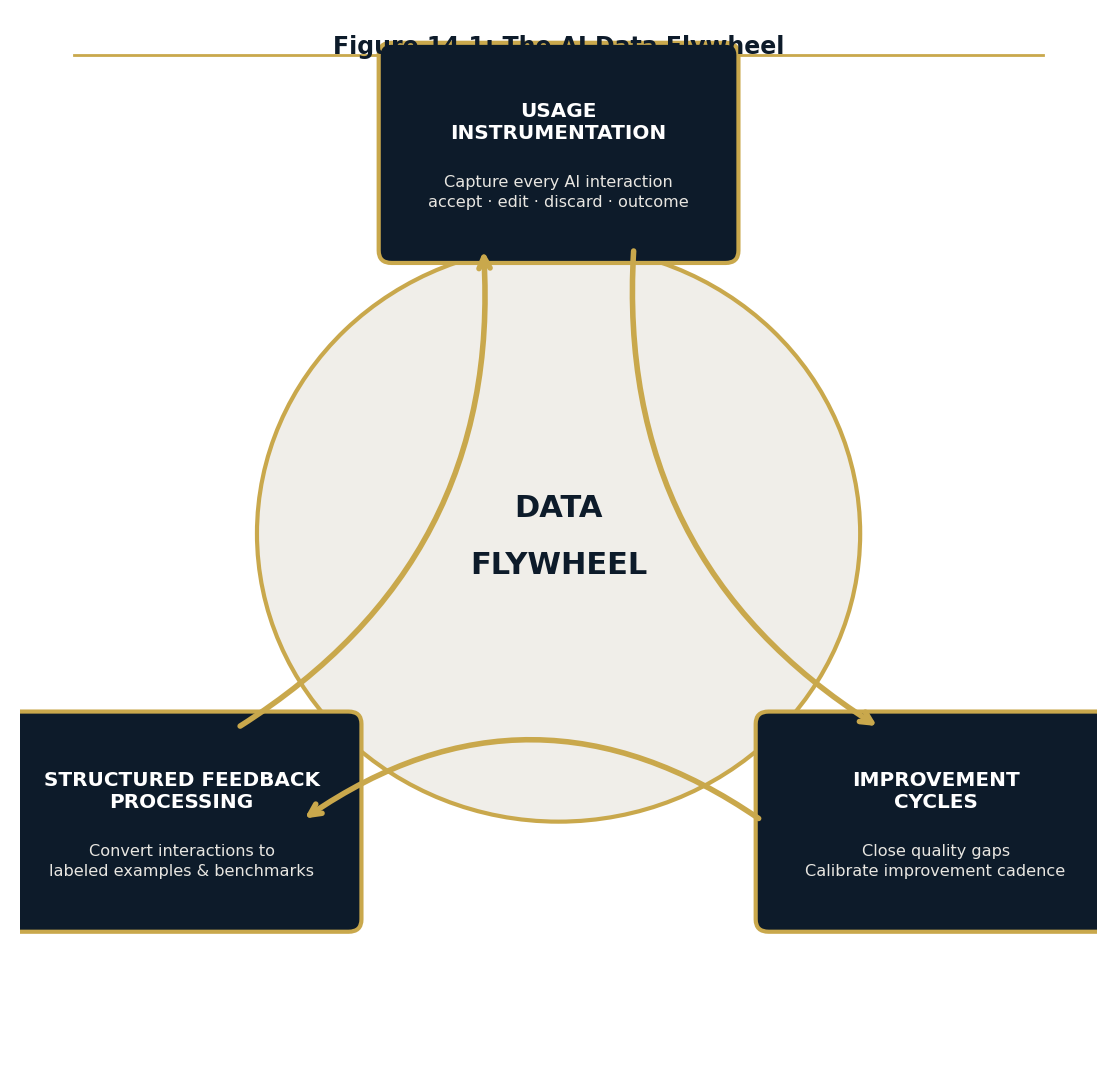
The most consequential long-term investment in AI transformation is one that most organizations underinvest in during the first year because its returns are not visible in the sprint’s metrics: the data flywheel. The data flywheel is the virtuous cycle in which AI usage generates data that improves the AI systems, which generates more usage, which generates more data. Organizations that build the infrastructure to capture this cycle accumulate a competitive asset that is genuinely difficult for later entrants to replicate. Organizations that do not build it are using AI without accumulating the structural advantage that AI makes available.
The data flywheel has three components, all of which must be present for the cycle to run. The first is usage instrumentation: the systematic capture of every AI interaction, including not just the outputs but the inputs, the context, the user’s response (did they accept, edit, or discard?), and the downstream outcome when it is observable (did the accepted output produce the expected result, or did a follow-up indicate a problem?). Most organizations capture some of this: the acceptance rate metrics from the calibration protocol, the basic API usage logs, but not all of it, and the gaps are where the most valuable signal lives. A user who edits an AI draft before sending it is communicating something specific about where the AI’s output diverged from the right answer. Capturing that edit and connecting it to the specific context that produced the draft is the highest-quality training signal available to the AI program, and it requires deliberate instrumentation to capture.
The second component is structured feedback processing: the conversion of raw interaction data into labeled examples, evaluation benchmarks, and improvement hypotheses that the AI team can act on. Raw data accumulates without value unless someone is processing it into the form that drives improvement. This processing work is typically underestimated in scope and underresourced in staffing, because it does not produce the visible artifacts that sprint work produces. The engineer who processes a month of interaction data into a new evaluation benchmark has produced something genuinely valuable, but the value is invisible until the benchmark reveals a quality gap that drives a significant improvement. Organizations that build a dedicated function for this work, and that treat it as a core part of the AI program rather than an afterthought, accumulate evaluation infrastructure that compounds: each new benchmark extends the team’s ability to detect and respond to quality changes before they reach customers.
The third component is model and system improvement cycles that are calibrated to the data flywheel’s cadence rather than to arbitrary sprint timelines. The question the improvement cycle should answer is not “what can we ship in the next two weeks?” but “what does the data from the last thirty days tell us about where the biggest quality gaps are, and what change would close the most important one?” The cadence of the improvement cycle should be driven by the rate at which new signal accumulates in the data, not by the management calendar.
AI-Native Product Development
The product development practice that produces AI-native capabilities is meaningfully different from the practice that produced the first sprint’s AI system, and the difference compounds over time. In the sprint, the product manager wrote a use case, the engineering team built a system to address it, and the evaluation framework was designed around the use case’s specific quality requirements. This is a project-based model: a discrete initiative with a defined output. It works for the first system and the second, but it does not scale into the AI-native practice that the long-term vision requires.
AI-native product development is organized around continuous improvement of a portfolio of AI systems rather than discrete delivery of individual AI features. The product manager’s primary job is not to define new AI use cases (though that remains part of the role) but to maintain a clear picture of the quality gaps across the existing portfolio, the business outcome gaps that those quality gaps are producing, and the improvement investments that would close the most consequential gaps most efficiently. This requires the product manager to be deeply embedded in the evaluation data, to have standing relationships with the business stakeholders who can translate quality gaps into business impact, and to understand the AI team’s improvement capacity well enough to make realistic prioritization decisions.
The engineering team’s practice in AI-native product development is organized around the continuous evaluation discipline: the set of practices for monitoring production AI systems, detecting quality drift, running improvement experiments, and deploying changes with confidence. This discipline is more demanding than the evaluation work of the sprint because it must operate across multiple production systems simultaneously, because the failure modes it needs to detect become more subtle as the systems mature, and because the improvement experiments must be designed and analyzed with enough rigor to distinguish genuine quality improvements from statistical noise. Teams that develop this discipline build a genuine competitive capability; teams that treat evaluation as a one-time gate rather than a continuous practice degrade their AI systems over time without necessarily knowing it.
The Compound Effect of Continuous Improvement
The competitive significance of the continuous evaluation discipline is not apparent in the first year of AI transformation. In year one, the organization with a rigorous evaluation practice and the organization with a casual one are producing AI systems of roughly similar quality, because both are building on the same foundation models and neither has had time to accumulate the improvement cycles that differentiate them. By year two, the gap begins to appear: the organization with continuous evaluation is shipping improvements faster, detecting regressions before they reach customers, and building a library of evaluation benchmarks that allows them to understand their AI systems’ quality at a level of granularity that competitors cannot match. By year three, the gap is structural: the organization with continuous evaluation has AI systems that are meaningfully better than what a new entrant could build in the same time, because the quality of those systems reflects not just the foundation model’s capability but the accumulated improvement work of eighteen months of rigorous evaluation cycles.
This is the compound advantage that AI-native operation produces, and it is the reason that the organizations that invest in the evaluation discipline in year one, when the returns are not visible, are the ones that hold the widest competitive moats in year three.
Talent and Structure at Scale
The organizational model that sustains AI-native operations at scale looks different from the model that ran the first sprint, and the transition between them requires deliberate design rather than organic evolution. Most organizations that reach the end of year one have an informal AI function: Thomas’s working group, or its equivalent, a small team of engineers who have developed AI expertise through the work of the sprint and the mid-term operating period. This informal structure is appropriate for the first year. It is not appropriate for the second, because the complexity of operating a portfolio of AI systems while developing new ones, while managing a growing data infrastructure, while supporting a business that is increasingly dependent on AI quality, exceeds what an informal structure can sustain.
The formal AI function that year two requires has three distinct components. The first is AI systems engineering: the team responsible for building new AI systems and operating existing ones. This team needs the full range of AI system development skills, including prompt engineering, retrieval architecture, evaluation methodology, and the operational practices that production AI systems require. It should be led by someone with both technical depth and organizational authority, not informally, as the de facto lead, but formally, as the recognized owner of the AI systems portfolio.
The second component is AI data and evaluation: the function responsible for the data flywheel, the evaluation infrastructure, and the continuous improvement process. This function is often neglected in favor of the more visible engineering work, but it is the function that determines whether the AI program is accumulating structural advantage or just maintaining the status quo. Its output is not features or systems; it is the evaluation benchmarks, the labeled data assets, and the improvement hypotheses that enable the engineering team to improve systematically rather than reactively.
The third component is AI product management: the practice of maintaining the portfolio view, translating business outcomes into AI quality requirements, and making the prioritization decisions that determine which improvement investments produce the most business value. This is a distinct skill set from traditional product management, and it requires individuals who can operate at the intersection of AI system quality, evaluation methodology, and business outcome analysis.
The organizational question that most teams at the end of year one are wrestling with is whether these three components should sit in a dedicated AI function or be distributed across existing engineering and product teams. The answer depends on the organization’s scale and the maturity of its AI program, but the general principle is clear: the functions that are most critical to the AI program’s long-term health, and most likely to be crowded out by other priorities if not given dedicated ownership, should have dedicated ownership. For most B2B SaaS companies in year two of AI transformation, that means at minimum a dedicated AI systems lead with formal authority and a dedicated AI data and evaluation function, even if the AI product management work remains distributed across the existing product team.
The Long-Term Competitive Picture
The organizations that will hold the strongest AI competitive positions in year three and beyond are not necessarily the ones that started earliest or invested most heavily. They are the ones that built most deliberately: that invested in the data flywheel infrastructure before the returns were visible, that developed the continuous evaluation discipline before it was strictly required, and that designed the AI organizational model for the scale they were building toward rather than the scale they were currently at. These investments look like overhead in year one. They look like structural advantage in year three.
The competitive dynamic that B2B SaaS companies navigating AI transformation are operating in has a characteristic that makes deliberate investment particularly consequential: the capability gap between organizations with strong AI programs and those with weak ones widens non-linearly over time. An organization that is six months behind in AI transformation is not six months behind in AI capability; it is behind by the compound improvement cycles that the leading organization has completed in those six months, and catching up requires not just building what the leader has built but building it while the leader continues to improve. The gap that is bridgeable in year one becomes structurally difficult to close in year three, not because of technical lock-in but because of the accumulated data assets, evaluation infrastructure, and organizational capability that the leader has built and that cannot be replicated quickly regardless of investment level.
This dynamic is the strongest argument for the deliberate investment posture that the long-term vision requires. The organizations that treat AI transformation as a one-time initiative, that ship the first system and then maintain rather than compound, that build the sprint’s evaluation framework and never extend it, are not maintaining their competitive position relative to more deliberate programs. They are falling behind at an accelerating rate, in ways that will not be fully visible until the gap is wide enough to show up in win rates, churn rates, and customer satisfaction scores.
Nexus in Focus: Eighteen Months Later
James had not expected to be in the position he was in. Eighteen months after the first AI sprint ended, Nexus’s AI program had produced results that, when he looked at them clearly, surprised even him. Churn was down from 12% to 8.4% annually. Average onboarding time had dropped from five weeks to eleven days. The CS team was handling a customer-to-rep ratio of 31 accounts per rep, up from 23, without any degradation in satisfaction scores. The work order classification assistant had a 79% acceptance rate across the customer base. David’s team had closed four deals in the past quarter where the AI features were explicitly cited as the deciding factor.
But what surprised James was not the numbers. It was a conversation he had with a prospect at a field service industry conference six weeks earlier. The prospect, a 200-person facility management company evaluating three platforms, had told James directly: “Your competitors tell me they’re working on AI features. You show me AI that’s been in production for over a year and improving every month. That’s a different conversation.” The prospect had signed two weeks later.
Marcus had built the AI function deliberately over the eighteen months. Thomas was now Head of AI Systems, with a formal title and a team of four engineers dedicated to AI systems work. A data engineer whose primary responsibility was the evaluation infrastructure and the data flywheel had been hired in month eight. The evaluation dashboard that had started as a shared spreadsheet was now a production system with disaggregated quality tracking across seven AI enablement points, real-time production monitoring, and a weekly anomaly report that went to the full AI council. The labeling pipeline that Thomas had built to process interaction data into evaluation benchmarks was producing approximately 400 labeled examples per week from production traffic, without any manual annotation effort from the engineering team.
Sarah had redesigned the product development process in month ten. New AI features no longer started from use case definitions; they started from the evaluation data’s most significant quality gaps. The product roadmap had a new section called “improvement investments,” distinct from the “new capability” section, that represented approximately 40% of the AI team’s capacity. James had initially questioned the allocation. Sarah’s response had been direct: “The improvement investments are what separate us from a competitor who ships the same features six months from now. The new capabilities are what we show prospects. Both matter.”
Elena had built the AI program’s business case for the Series C investors. The numbers were strong. But the part of the investor presentation that generated the most questions was not the numbers. It was the slide that described the data flywheel: the labeled data assets, the evaluation infrastructure, the improvement cycle cadence, the compound quality improvement rates. One investor asked how long it would take a new entrant to replicate the evaluation infrastructure. Marcus answered: “The code? Two months. The labeled data and the calibrated benchmarks that reflect eighteen months of production traffic? You can’t replicate that. You have to earn it.”
If You’re Buying, Not Building
The long-term competitive picture looks different for organizations that purchase AI capabilities than for those that build them, and the difference is worth naming honestly. A vendor-supplied AI capability cannot produce a data flywheel that compounds in your favor, because the interaction data that flows through a vendor’s system belongs to the vendor’s improvement program, not yours. The labeled data assets that your customers generate through their use of the vendor’s AI features are the vendor’s most valuable competitive asset, and they are not yours.
This does not mean that buying AI capability is the wrong choice, especially in the early phases of transformation when building is expensive and slow. But it does mean that organizations relying primarily on vendor-supplied AI capabilities need a clear-eyed view of what they are and are not accumulating. They are accumulating product capability and customer adoption. They are not accumulating data assets, evaluation infrastructure, or the organizational capability that building AI systems develops. The long-term competitive position of an organization whose AI program is primarily vendor-sourced is dependent on the vendor’s improvement trajectory, not the organization’s own.
The strategic question for organizations that have followed a buy-first approach is not whether to switch to building, but when and where to begin building, so that the organization starts accumulating its own data assets and organizational capability before the window for doing so at reasonable cost closes. The organizations that ask this question in year two are in a better position than the ones that ask it in year four.
Key Takeaways
- The goal of the long-term horizon is not to maintain AI capability but to cross the boundary from AI-augmented to AI-native: from AI that assists existing workflows to AI that constitutes new workflows that would not be possible without it. This crossing requires a different set of investments than the first year demanded, and the distance between augmented and native is larger than most organizations appreciate from inside year one.
- The data flywheel is the most consequential long-term investment in AI transformation and the most commonly underinvested in year one. It requires usage instrumentation that captures not just outputs but context and user responses, structured feedback processing that converts raw interaction data into labeled examples and evaluation benchmarks, and improvement cycles calibrated to the data’s accumulation rate rather than the management calendar.
- AI-native product development is organized around continuous improvement of an AI portfolio rather than discrete delivery of individual AI features. The product manager’s primary job evolves from defining use cases to maintaining the quality gap and business outcome gap picture that drives improvement prioritization. The engineering team’s primary discipline evolves from building systems to operating them under continuous evaluation.
- The compound advantage of the continuous evaluation discipline is not visible in year one and decisive by year three. Organizations that invest in this discipline before the returns are clear are the ones that hold structural competitive advantages when competitors begin catching up, because the labeled data assets and calibrated evaluation infrastructure that the discipline produces cannot be replicated quickly regardless of investment level.
- The formal AI function that year two requires has three components: AI systems engineering, AI data and evaluation, and AI product management. The functions most critical to the program’s long-term health and most likely to be crowded out by other priorities should have dedicated ownership, not informal ownership through whoever has developed the most expertise.
- The competitive gap between organizations with strong AI programs and those with weak ones widens non-linearly over time. The gap that is bridgeable in year one becomes structurally difficult to close in year three. Organizations that treat AI transformation as a one-time initiative fall behind at an accelerating rate, in ways that become visible in business outcomes before they become visible in the AI program’s metrics.
Action Items
- Assess your current position on the augmented-to-native spectrum honestly. Where in your product and operations is AI assisting existing workflows, and where is it constituting new workflows that would not be practical without it? Identify the highest-value opportunity to move from augmented to native in one specific area in the next twelve months, and define what the organizational and technical investments that move requires.
- Audit the data flywheel infrastructure. Are you capturing user responses to AI outputs (accept, edit, discard) at the granularity needed to drive improvement? Is someone processing interaction data into labeled examples and evaluation benchmarks on a regular cadence? If not, define the minimum viable flywheel: the instrumentation additions, the processing cadence, and the ownership that would get the cycle running.
- Define the formal AI function structure for year two. Who owns AI systems engineering, with what authority? Who owns AI data and evaluation, as a dedicated function rather than a shared responsibility? Who owns AI product management? Design the structure for where the program needs to be in eighteen months, not where it is today.
- Build the “improvement investments” allocation into the AI roadmap explicitly. Define what percentage of the AI team’s capacity is allocated to improving existing systems versus building new ones, and make that allocation a deliberate decision reviewed quarterly by the AI council rather than an outcome of whatever the team is pulled toward by the most recent request.
- Prepare the long-term competitive narrative for your board and investors. Articulate not just what AI capabilities you have shipped but what structural assets you are accumulating: the labeled data, the evaluation infrastructure, the organizational capability, the improvement cycle cadence. These are the assets that determine your competitive position in year three, and they deserve the same board-level visibility as the product roadmap and the financial projections.